Licht
빛
1. The Site of the Work
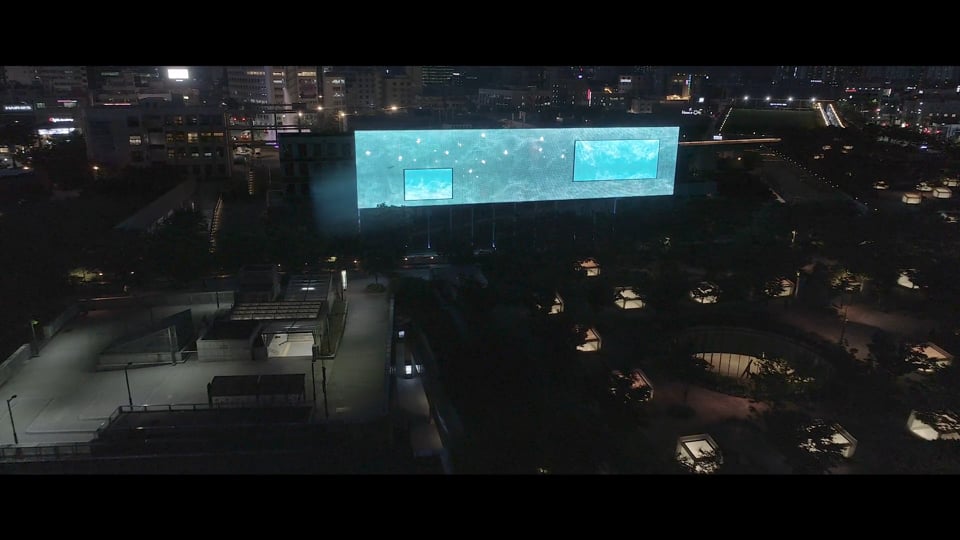
The media wall at the Asia Culture Center stands back-to-back with the old Jeollanam-do Provincial Office — now the Democracy and Human Rights Center for Peace — the final site of resistance in the May 18 Democratization Movement. While video plays, the mesh-material media wall conceals what lies behind it: the ground where the uprising actually took place. The surface spectacle risks obscuring the real place and event behind it.
In response, portraits of the martyrs were hung before the provincial office, and thirty-eight lights were installed in front of them. The moment the video disappears, the lights come on and illuminate the faces. This transition — where the vanishing of the image meets the emergence of light — is the center of the work.
1. 작업의 자리
아시아문화전당의 미디어월은 5·18 마지막 항쟁지였던 옛 전남도청 — 지금의 민주평화교류원 — 과 등을 맞댄 한 몸이다. 매쉬(Mesh) 재질의 미디어월은 영상이 상영되는 동안 그 뒤, 실제로 항쟁이 일어난 자리를 가린다. 표층의 스펙터클이 그 배후의 실제 장소와 사건을 은폐할 수 있다는 긴장이다.
이에 대한 응답으로 도청 앞에 열사들의 얼굴을 내걸고, 그 앞에 서른여덟 개의 빛을 세웠다. 영상이 사라지는 순간 빛이 켜지며 얼굴들을 비춘다. 이미지의 소멸과 빛의 발현이 겹치는 이 찰나가 작업의 중심이다.
2. Jesus Is Light
Light is Jesus. That light illuminates the face.
"I am come a light into the world, that whosoever believeth on me should not abide in darkness." — John 12:46
The ten titles trace an arc: Soundless Shouting (5/18), Standing Up (5/19), Moving Forward (5/20), Revealing Truth (5/21), Comforting (5/22), Vanishing (5/23), Seeking (5/24), The Reason (5/25), March of the Dead (5/26), Into the Darkness (5/27) — a rhythm of revelation and concealment.
After 5/27, “Light, Was. And the Resurrection of Light” reframes this vanishing as the darkness before resurrection, not a final one. This lineage of light, carried into the candlelight vigils, testifies to May 18 as an event that keeps being relit. A face shone once and disappeared, but that light is relit in another hand, another candle.
2. 예수는 빛이다
빛은 예수다. 그 빛이 얼굴을 비춘다.
“나는 빛으로 세상에 왔나니 무릇 나를 믿는 자로 어둠에 거하지 않게 하려 함이로라” — 요한복음 12:46
열 개의 제목은 소리 없는 아우성(518)에서 일어서고(519) 전진하며(520), 드러내고(521) 위로한 뒤(522), 사라지고(523) 찾고(524) 그 이유를 묻고(525), 죽음의 행진(526)과 어둠 속으로(527)의 궤적을 이룬다. 계시와 은폐가 교대하는 리듬이다.
527 이후, “빛, 있었다. 그리고 빛의 부활”은 이 소멸을 부활 앞의 어둠으로 자리매김한다. 촛불집회로 이어지는 이 빛의 계보는 끝난 사건이 아니라 계속 다시 켜지는 사건으로서 5·18을 증언한다. 얼굴은 한 번 빛나고 사라졌지만, 그 빛은 다른 손, 다른 촛불에서 다시 켜진다.
3. The Face Opened by Light
For Balthasar, recognizing a face is an ontological event — as an infant learns beauty, goodness, and truth from its mother's face. To lose sight of a face, like Cain whose "countenance fell" before God, is to lose relationship and humanity itself.
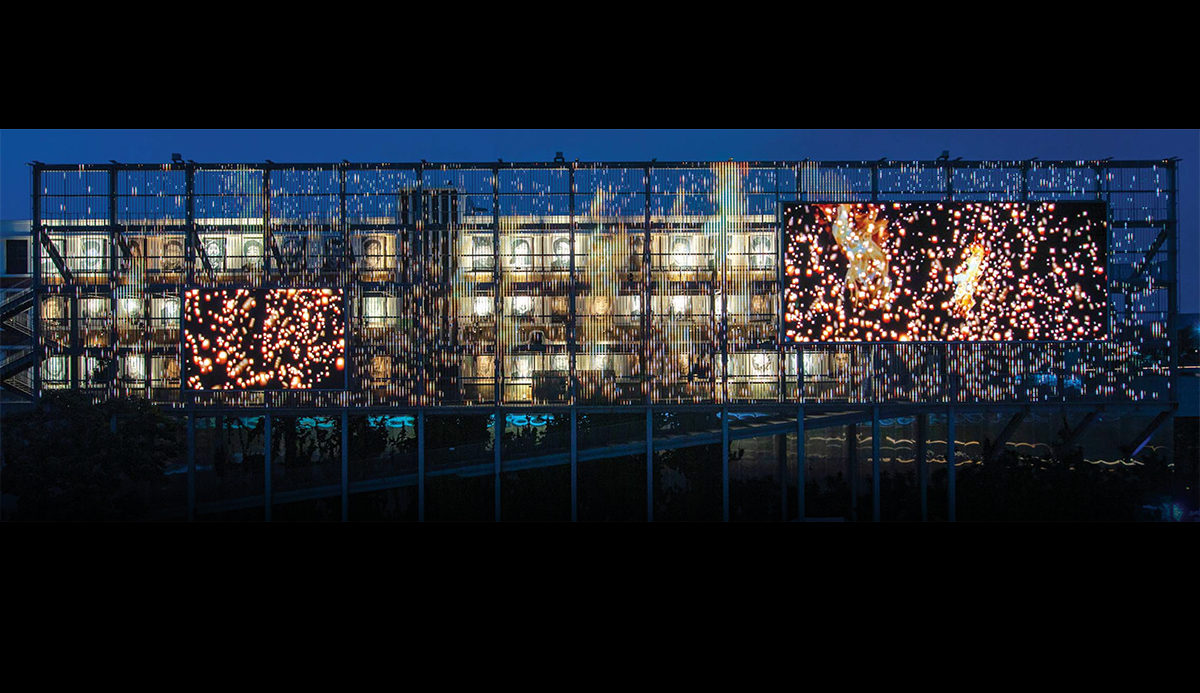
The photograph of this installation shows that contrast directly. The grid of windows, each holding a face, is an independent form through which — as with the form of Christ for Balthasar — glory becomes visible: not an anonymous death, but a named one. The countless red and gold specks scattered across the other screen are light without form — particles never individuated into a face, close to the "totality" Levinas warned against. For Levinas the face is not an image but an expression; its deepest meaning is the first commandment, "Thou shalt not kill."
The moment the lights come on and the windows brighten is the event that returns this mass to a face — nameless points restored to faces, to names, to "you."
Paul wrote of "the light of the knowledge of the glory of God in the face of Jesus Christ" (2 Corinthians 4:6). The moment the thirty-eight lights opened the faces was not a metaphor for this verse but the event itself: this light was Jesus.
3. 빛으로 열리는 얼굴
발타자르에게 얼굴의 인식은 존재론적 사건이다. 아기가 처음 마주하는 ‘엄마의 얼굴’에서 아름다움과 선함과 진리를 배우듯, 얼굴은 무한자와 유한자를 잇는 통로다. 반대로 얼굴을 볼 수 없다는 것, 창세기의 카인처럼 “얼굴을 떨어뜨리는” 것은 관계의 단절이자 인간성의 상실이다.
이 설치의 사진은 이 대비를 그대로 보여준다. 격자로 늘어선 창, 그 안의 얼굴들은 각각 하나의 형상(Gestalt)이며 이름을 가진 죽음으로 자신을 드러낸다. 반면 오른쪽 스크린에 흩뿌려진 붉고 금빛의 무수한 점들은 얼굴로 개별화되지 못한 채 흩어지는 빛 — 레비나스가 경계한 ‘전체성’의 이미지다. 레비나스에게 얼굴은 형상이 아니라 표현이며, 그 근원적 의미는 “살인하지 말라”는 최초의 계시다.
빛이 켜지며 매쉬 뒤 창들이 밝아지는 순간은 이 무리를 다시 얼굴로 되돌리는 사건이다 — 전체성의 무명한 점들을 다시 얼굴로, 다시 이름으로, 다시 “너”로.
바울은 “하느님의 영광을 아는 빛이 그리스도의 얼굴에 있다”고 썼다(고린도후서 4:6). 매쉬 뒤에서 켜진 서른여덟 개의 빛이 얼굴을 여는 순간은 이 구절의 은유가 아니라 사건 자체였다: 이 빛은 예수였다.
4. The Mesh Wall: Between Idol and Icon
Jean-Luc Marion distinguishes the idol from the icon by where the gaze comes to rest. The idol is a mirror — the gaze stops at the surface, reflecting only the viewer's own intention. The icon is a window — it lets the gaze pass through, toward the invisible.
The mesh wall, while playing video, resembles an idol. But the moment the video disappears and light illuminates the faces, the mesh turns translucent and becomes an icon. The gaze passes through the faces toward the events of May 1980.
4. 매쉬월: 우상과 이콘 사이
장뤽 마리옹은 우상과 이콘을 시선이 어디서 멈추는가로 구분한다. 우상은 거울이다 — 시선은 표면에서 멈추고 보는 자 자신을 되비출 뿐이다. 이콘은 창문이다 — 시선을 붙잡지 않고 보이지 않는 것을 향해 열어준다.
영상이 상영되는 매쉬월은 우상에 가깝다. 그러나 영상이 사라지고 빛이 얼굴을 비추는 순간, 매쉬는 반투명해지며 이콘으로 전환된다. 시선은 얼굴 너머, 1980년 5월의 사건을 향해 통과한다.
5. The Vanishing Presence
At this moment of transition, the performer briefly stands and disappears. Not representing anything — simply present for a moment, connecting the audience and the martyrs, then withdrawing. This presence, wholly given yet never possessed, resonates with the way the risen Christ "vanished from their sight" the instant he broke bread at Emmaus.
5. 사라지는 현존
이 전환의 순간 퍼포머가 잠시 서 있다가 사라진다. 재현하지 않는다 — 다만 잠시 있음으로써 관객과 열사들을 이어주고 물러난다. 온전히 내어주면서도 소유되지 않는 이 현존은, 부활 후 엠마오에서 빵을 떼는 순간 “사라지신” 그리스도의 방식과 공명한다.
6. The Last Night, Toward the Last Supper
On the final night, those who remained in the provincial office knew that staying meant death — and still they did not leave. A body voluntarily remaining in the face of death overlaps with the scene of the Last Supper. "This is my body, given for you" is not the language of escape but of self-giving.
This form of the last night became the decisive impetus for later giving form to the Last Supper of the Mass. Licht interprets the events of Gwangju through a biblical frame — and that interpretation, in turn, lets us see the Last Supper anew.
6. 마지막 밤, 최후의 만찬으로 가는 길
마지막 밤, 도청에 남은 이들은 남으면 죽는다는 것을 알면서도 떠나지 않았다. 죽음을 향해 자발적으로 머무르는 몸 — 이는 최후의 만찬의 자리와 겹친다. “이는 너희를 위하여 주는 내 몸이니라”는 도피가 아니라 자기증여의 말이다.
이 마지막 밤의 형상은 이후 미사의 최후의 만찬을 형상화하는 결정적 계기가 되었다. Licht는 광주의 사건을 성서적 틀로 해석한 작업이면서, 동시에 그 해석이 다시 최후의 만찬을 새롭게 보게 만드는 순환적 구조를 가진다.
영상 보기 / Films