
Living Altar · Chapel
살아있는 제대 · 성체조배실
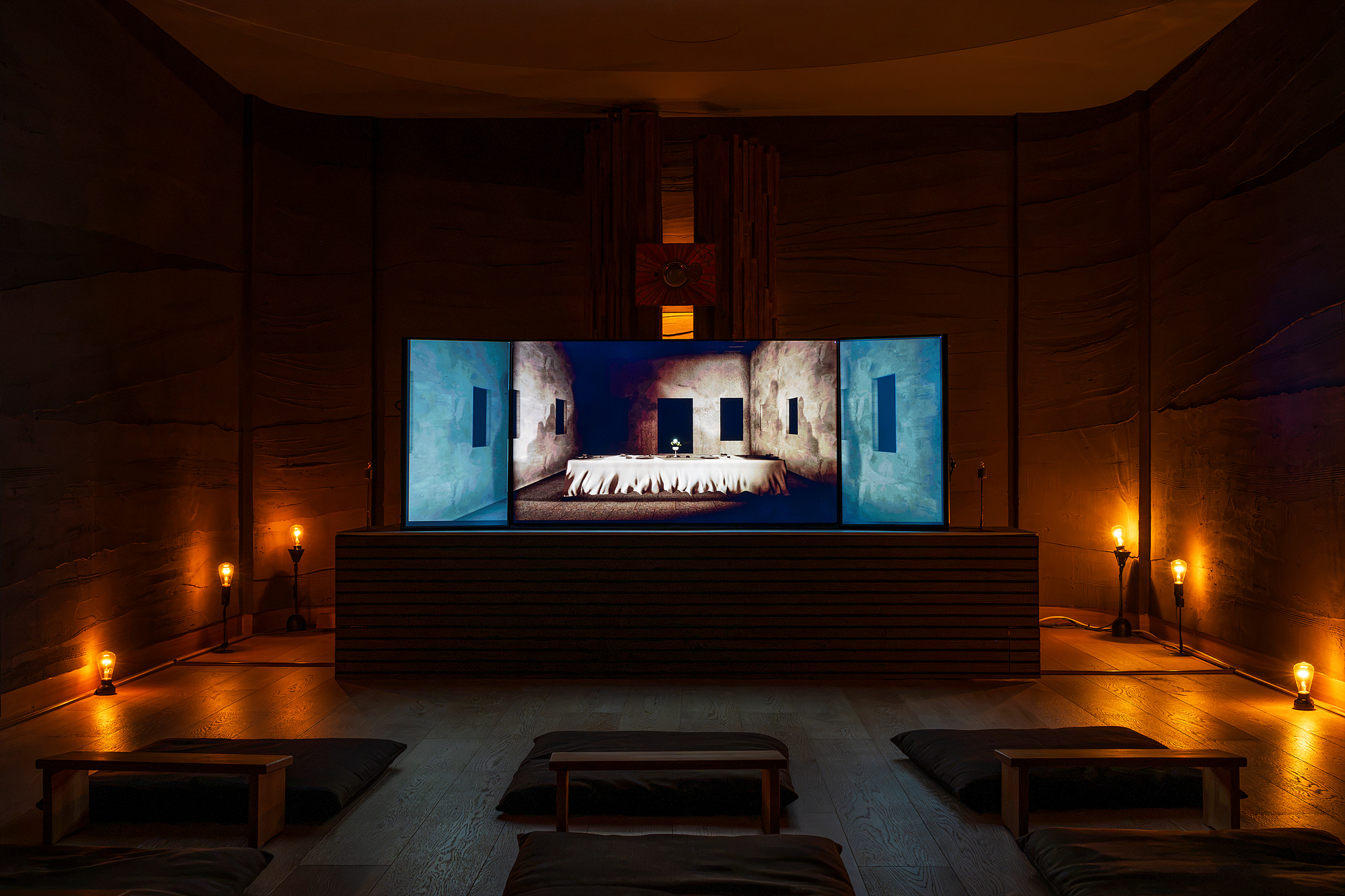
The Solemnity of the Body and Blood of Christ traces its origin to the 13th century, to a vision granted to Saint Juliana of Liège in Belgium. She saw a full moon with a single dark blemish — the Lord revealed to her that this blemish signified the absence of a feast not yet instituted. After Juliana made the vision known, the Solemnity was established with papal approval. This work, too, begins from that image of the moon.
Beneath the moonlight, two angels light candles in a tree. The flames transform into the fire of the burning bush — the bush that is not consumed — and that fire then ignites the two candlesticks present in this very space, announcing that the video begins as a sacrifice offered to God. With the sound of a small bell, we enter a space from two thousand years ago. An ambiguous silhouette leads us — whether this is the Upper Room where the Last Supper and the institution of the Eucharist took place, or the Mass being celebrated even today, we cannot say.
There, hands alone appear quietly and speak: "This is my body. This is my blood." These words are inscribed as text as well. Through a window in the distance, a lamb is visible — the Lamb of God, the Paschal sacrifice. Jesus offers His own body and blood as the sacrifice. The window of the Last Supper then shatters — this is the decision made in Gethsemane, and at the same time it reveals, with overwhelming force, how His body is broken and His blood is shed as He comes to us.
In the scene of the scourging and the crown of thorns, the light beats upon us ceaselessly. I wanted the sound, the light, and the images to pierce and rupture our senses. For I believe that the suffering Jesus endured bodily two thousand years ago is incomparably beyond what we can experience indirectly today. The sound of the whip rises to the sound of the nail, and the heartbeat stops at the culminating words, "It is accomplished."
Above the empty tomb, the cloth that covered Jesus's body slowly rises with the sound of a bell, announcing the Resurrection. Beneath it, His body is absent. Once again two angels appear — at the head and at the feet — and proclaim as Scripture says: "He is not here. He has risen."
The absence of the body points to the Resurrection, and that absent body is now present in the Eucharist. The body of Jesus that has disappeared is present here and now, coming to us. What immense gratitude it is to participate in the Mass and receive His risen body — this work was made for exactly that meaning. Through the decision of the Last Supper and Gethsemane, broken and suffering, He has finally risen and is with us. As it was in the beginning, is now, and ever shall be. Amen.
성체성혈 대축일은 1200년대, 벨기에의 성녀 율리아나의 환시에서 비롯됩니다. 늘 검은 흠이 하나 있는 보름달—주님께서는 그 흠이 아직 제정되지 않은 이 대축일을 뜻한다고 알려 주셨습니다. 율리아나가 환시를 알린 끝에 교황의 인가로 대축일이 제정되었고, 이 작업도 그 달의 이미지에서 시작됩니다.
달빛 아래, 두 천사가 나무에 초를 켭니다. 그 촛불은 불타지 않는 떨기나무의 불로 변하고, 그 불은 실제로 이 공간의 두 촛대에 불을 밝혀, 하느님께 드리는 희생 제사로서 영상이 시작됨을 알립니다. 작은 종소리와 함께 우리는 이천 년 전의 공간으로 들어섭니다. 그곳이 최후의 만찬, 곧 성찬례가 제정된 자리인지, 아니면 오늘도 거행되는 미사인지 알 수 없는 모호한 실루엣이 우리를 인도합니다.
그곳에서 손만이 조용히 나타나 말씀하십니다. "이는 내 몸이다. 이는 내 피다." 이 말씀은 텍스트로도 함께 새겨집니다. 창문 너머 멀리 어린양이 보입니다. 하느님의 어린양, 곧 파스카의 희생양입니다. 예수님께서는 당신 자신의 몸과 피를 제물로 바치십니다. 이내 최후의 만찬 창문이 깨지는데, 이는 겟세마니에서의 결단인 동시에, 당신의 몸이 찢기고 피 흘리시어 우리에게 오심을 압도적인 감각으로 드러냅니다.
곧이어 채찍과 가시관의 장면에서, 조명은 끊임없이 우리를 두드립니다. 저는 소리와 조명과 영상이 우리의 감각을 찌르고 파열시키기를 바랐습니다. 이천 년 전 예수님께서 온몸으로 겪으신 수난은, 지금 우리가 간접적으로 체험하는 것과는 비할 수 없으리라 생각하기 때문입니다. 채찍소리는 못소리로 고조되고, 심장소리는 "다 이루어졌다"는 말씀을 정점으로 멎습니다.
빈 무덤 위, 예수님의 몸을 덮었던 천이 종소리와 함께 천천히 올라가며 부활을 알립니다. 그 아래 그분의 몸은 부재합니다. 좌우에 다시 두 천사가 나타나, 성경의 말씀처럼 머리맡과 발밑에서 선언합니다. "그분은 여기 계시지 않는다. 그분께서는 부활하셨다."
몸의 부재는 부활을 가리키고, 사라진 그 몸은 성체로 현존하십니다. 사라진 예수님의 몸은 성체로서, 지금 이곳에 현시되어 우리에게 오십니다. 미사에 참례하여 그분의 부활하신 몸을 영하는 일이 얼마나 큰 감사인지—이 작업은 바로 그 의미를 위해 만들어졌습니다. 처음과 같이 이제와 항상 영원히. 아멘.
Ⅰ. Vision — The Moon and the Eucharist
The Eucharist placed beneath actual candlelight transitions into the moon within the video, beginning the vision of Saint Juliana. The moon becomes a sign that reflects the mystery of the Eucharist, and the viewer is invited into that light.
Ⅱ. Fire — The Burning Bush and Two Angels
Two angels light an inextinguishable flame, consecrating the space. This is both the beginning of a sacrifice offered to God and an evocation of the divine presence that appeared in the burning bush.
Ⅲ. Ambiguous Time — Supper or Mass?
Among figures revealed only as shadows, time grows blurred. The Last Supper and today's Mass mirror each other, overlapping within a single mystery.
Ⅳ. The Hands — The Words of Institution
The hands of the priest — and of Jesus — raise the bread and the cup. 'My body given for you,' 'my blood poured out for you' are proclaimed, and the promise of sacrifice begins.
Ⅴ. Gethsemane | The Lamb of God — Shattering Glass
The shattering of glass marks the turning point from the anguish of Gethsemane to the act of obedience. The Lamb of God accepts, beyond all fear, the sacrifice of giving His body and blood.
Ⅵ. The Passion — The Whip and the Nail
The sounds of the whip and the nail intensify by degrees. The suffering of two thousand years ago does not remain in the past; it resounds still in today's wounds and violence.
Ⅶ. It Is Accomplished — The Hinge
Not an ending, but a completion. The sacrifice promised at the Last Supper is fulfilled upon the cross. The hinge that connects death and resurrection, the Supper and the Mass, finally opens.
Ⅷ. Resurrection — Presence Through Absence
The empty burial cloth rises. The Resurrection is not a mere re-enactment but a new presence made manifest through absence. At the head and the feet, two angels proclaim: 'He is not here. He has risen.' The flame of the altar brightens again; the sacrifice now continues as Mass.
Ⅸ. Do This in Memory of Me
'Do this in memory of me.' Memory is not completed by receiving the Eucharist alone. It is only when we receive the body of Christ and participate in His life that memory at last becomes the present.
Ⅹ. The Eucharist Alone
All the images, light, sound, and scenes that have come before were not made to reveal themselves. All of it existed only to lead us toward the Eucharist. When all else has withdrawn, the Eucharist alone shines. We invite you to remain before it for a moment.
Ⅰ. 환시 — 달과 성체
실제 불빛 아래 모셔진 성체가 영상 속 달로 옮겨가며, 성녀 율리아나의 환시가 시작됩니다. 달은 성체의 신비를 비추는 표징이 되고, 관람자는 그 빛 안으로 초대됩니다.
Ⅱ. 불 — 떨기나무와 두 천사
두 천사가 꺼지지 않는 불을 밝혀 공간을 성별(聖別)합니다. 이는 하느님께 봉헌되는 희생제사의 시작이자, 떨기나무 가운데 나타나신 하느님의 현존을 상기시킵니다.
Ⅲ. 모호한 시간 — 만찬인가, 미사인가
그림자로만 드러난 인물들 사이에서 시간은 흐려집니다. 최후의 만찬과 오늘의 미사는 서로를 비추며 하나의 신비 안에서 겹쳐집니다.
Ⅳ. 손 — 제정사
사제이자 예수의 손이 빵과 잔을 들어 올립니다. "너희를 위하여 내어줄 몸", "너희를 위하여 흘릴 피"가 선포되며, 희생의 약속이 시작됩니다.
Ⅴ. 겟세마니 | 하느님의 어린양 — 깨지는 유리
유리의 파열이 겟세마니의 고뇌에서 순명으로 전환되는 결단의 순간을 가릅니다. 하느님의 어린양은 두려움을 넘어 자신의 몸과 피를 내어주시는 희생을 받아들입니다.
Ⅵ. 수난 — 채찍과 못
채찍과 못의 소리가 점차 고조됩니다. 이천 년 전의 수난은 과거에 머물지 않고, 오늘의 상처와 폭력 속에서도 계속 울려 퍼집니다.
Ⅶ. 다 이루었다 — 경첩
끝이 아니라 완성입니다. 최후의 만찬에서 약속된 희생은 십자가 위에서 성취됩니다. 죽음과 부활, 만찬과 미사를 잇는 경첩이 마침내 열립니다.
Ⅷ. 부활 — 부재의 현존
빈 수의가 떠오릅니다. 부활은 단순한 재현이 아니라, 부재를 통해 드러나는 새로운 현존입니다. 머리맡과 발밑, 두 천사의 선포 "그분은 여기 계시지 않는다. 그분께서는 부활하셨다." 다시 제대의 불이 커지며, 이제 희생제사는 미사로 이어집니다.
Ⅸ. 기억하여 행하라
"나를 기억하여 이를 행하여라." 성체를 받아 모시는 것으로 기억은 완성되지 않습니다. 그리스도의 몸을 받아 그분의 생명에 참여할 때, 기억은 비로소 현재가 됩니다.
Ⅹ. 오직 성체
지금까지의 영상과 빛, 소리와 모든 장면은 결국 자신을 드러내기 위한 것이 아니었습니다. 그 모두는 오직 성체를 향하도록 이끌기 위해 있었습니다. 그 모든 것이 물러난 자리에서, 마침내 성체만이 빛납니다. 이 성체 앞에 잠시 머무시기를 청합니다.
Acknowledgements
This work was never made alone. My deepest gratitude to all who prayed alongside and lent their hands until a single breath of video came to be.
Overall Advisor · Fr. Stephan Baek Woon-cheol
Supervision · Fr. Paul Shin Ji-cheol
Planning · Lucia Han Ji-yeon
Sound Design · Anna Ahn Eun-jeong
Green Screen Hand Filming · Paul Lee Young-hoon
Installation · Jang Jae-il
My heartfelt thanks to everyone at the parish who offered their help.
And above all, to each visitor who will stand before this work and respond in silence — thank you.
감사의 말
이 작품은 결코 홀로 이루어지지 않았습니다. 한 호흡의 영상이 되기까지 함께 기도하고 손을 보태어 주신 모든 분들께 깊이 감사드립니다.
총괄 자문 · 백운철 스테파노 신부님
감수 · 신지철 바오로 신부님
기획 · 한지연(루시아)
사운드 디자인 · 안은정(안나)
그린스크린 손 촬영 · 이영훈(바오로)
설치 · 장재일
도움을 주신 성당 모든분들께 깊은 감사를 드립니다.
무엇보다, 이 작품 앞에 머물러 침묵으로 응답해 주실 관람자 여러분께 감사드립니다.
오직 성체
이 성체 앞에 잠시 머무시기를 청합니다.